Selektivnost u postupanju Međunarodnog krivičnog suda – slučajevi Ukrajine i Palestine
DOI:
https://doi.org/10.5937/crimen2601036B%20Ključne reči:
Međunarodni krivični sud, nadležnost, komplementarnost, Ukrajina, PalestinaApstrakt
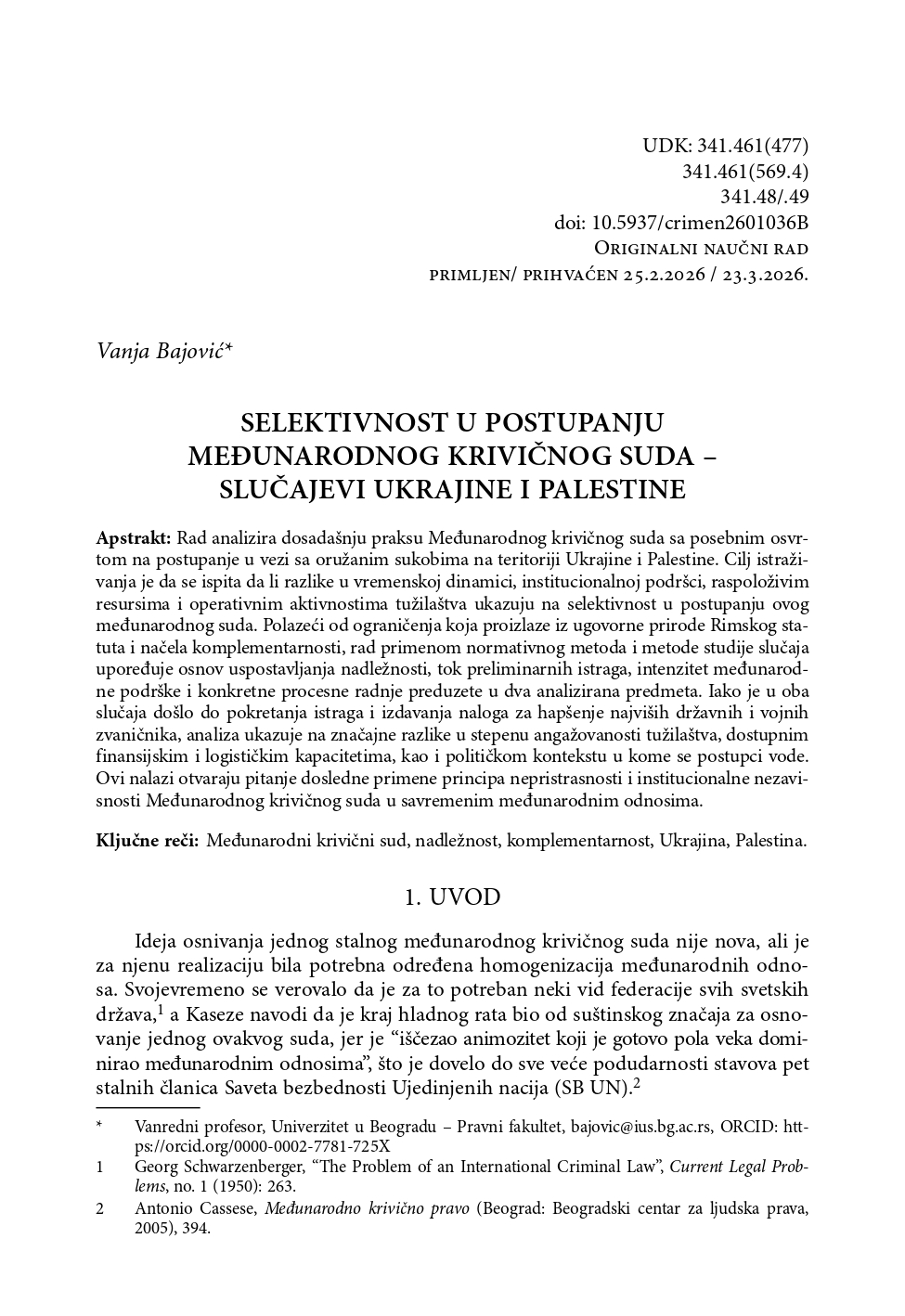
Rad analizira dosadašnju praksu Međunarodnog krivičnog suda sa posebnim osvrtom na postupanje u vezi sa oružanim sukobima na teritoriji Ukrajine i Palestine. Cilj istraživanja je da se ispita da li razlike u vremenskoj dinamici, institucionalnoj podršci, raspoloživim resursima i operativnim aktivnostima tužilaštva ukazuju na selektivnost u postupanju ovog međunarodnog suda. Polazeći od ograničenja koja proizlaze iz ugovorne prirode Rimskog statuta i načela komplementarnosti, rad primenom normativnog metoda i metode studije slučaja upoređuje osnov uspostavljanja nadležnosti, tok preliminarnih istraga, intenzitet međunarod ne podrške i konkretne procesne radnje preduzete u dva analizirana predmeta. Iako je u oba slučaja došlo do pokretanja istraga i izdavanja naloga za hapšenje najviših državnih i vojnih zvaničnika, analiza ukazuje na značajne razlike u stepenu angažovanosti tužilaštva, dostupnim finansijskim i logističkim kapacitetima, kao i političkom kontekstu u kome se postupci vode. Ovi nalazi otvaraju pitanje dosledne primene principa nepristrasnosti i institucionalne nezavi snosti Međunarodnog krivičnog suda u savremenim međunarodnim odnosima.
Downloads
Reference
Abdou, Mohamed. In Commentary on the Law of the International Criminal Court, ed. Mark Klamberg. Brussels: Torkel Opsahl Academic EPublisher, 2017. https://doi.org/10.1017/s2044251317000030
Abu Murad, Murad. “Jurisdiction of ICC over alleged war crimes and crimes against humanity against Palestinians under the complementarity principle.” Brawijaya Law Journal 11, no. 1 (2024): 112–134. https://doi.org/10.21776/ub.blj.2024.011.01.06
Akiko, Ivana. “The Role Of International Criminal Court In Command Responsibility Towards Benjamin Netanyahu At Israeli-Palestine Conflict.” Justices: Journal of Law 4, no. 4 (2025): 257–266. https://doi.org/10.58355/justices.v4i4.195
Arbour, Louise. “The Relationship between the ICC and the UN Security Council.” Global Governance 20, no. 2 (2014): 195–201. https://doi.org/10.1163/19426720-02002002
Becker, Steven W. “The objections of larger nations to the ICC.” Revue Internationale de Droit Pénal 81, no. 1–2 (2010): 47–64.
https://doi.org/10.3917/ridp.811.0047
Bergsmo, Morten. “The Jurisdictional Régime of the International Criminal Court.” European Journal of Crime, Criminal Law and Criminal Justice 4, no. 6 (1998): 30–41. https://doi.org/10.1163/15718179820518601
Brunger, Yassin M. In Commentary on the Law of the International Criminal Court, ed. Mark Klamberg. Brussels: Torkel Opsahl Academic EPublisher, 2017. https://doi.org/10.1017/s2044251317000030
Burke-White, William. “Implementing a Policy of Positive Complementarity in the Rome System of Justice.” Criminal Law Forum 19, no. 1 (January 2008): 59–85. https://doi.org/10.1007/s10609-007-9050-9
Cassese, Antonio. Međunarodno krivično pravo. Beograd: Beogradski centar za ljudska prava, 2005. https://doi.org/10.14712/12128112.3883
Conway, Gerard. In Commentary on the Law of the International Criminal Court, ed. Mark Klamberg. Brussels: Torkel Opsahl Academic EPublisher, 2017. https://doi.org/10.1017/s2044251317000030
Damaška, Mirjan. “Pravi ciljevi međunarodnog kaznenog pravosuđa.” Hrvatski ljetopis za kazneno pravo i praksu 15, no. 1 (2008): 13–33.
Drumbl, Mark A. “Pluralizing International Criminal Justice.” Michigan Law Review 103, no. 6 (May 2005): 1295–1322.
Holmes, John T. “The Principle of Complementarity”. In The International Criminal Court: the making of the Rome Statute – issues, negotiations, results, ed. Roy S. Leer. The Hague: Kluwer Law International, 1999. https://doi.org/10.1163/9789004639157_008
Kirsch, Philippe, John T. Holmes. “The Rome Conference on an International Criminal Court: The Negotiating Process.”, American Journal of International Law 93, no. 1 (January 1999): 2–12. https://doi.org/10.2307/2997952
Malanczuk Peter. Akehurst’s Modern Introduction to International Law. New York: Routledge, 1997.
Murphy, Sean D. “U.S. Bilateral Agreements Relating to the ICC.” American Journal of International Law 97, no. 1 (2017): 200–203. https://doi.org/10.2307/3087129
Müller, Andreas, Ignaz Stegmiller. “Self-Referrals on Trial: From Panacea to Patient.” Journal of International Criminal Justice 8, no. 5 (2010): 1267–1291. https://doi.org/10.1093/jicj/mqq072
Osiel, Mark. “The Banality of Good; Aligning Incentives Against Mass Atrocity.” Columbia Law Review 105, no. 6 (2005): 1751–1862.
Schabas, William A. An Introduction to the International Criminal Court. Cambridge: Cambridge University Press, 2007.
Schabas, William A. The International Criminal Court: A Commentary on the Rome Statute. Oxford: Oxford University Press, 2010. https://doi.org/10.1093/law/9780199560738.001.0001
Schabas, William A. “United States Hostility to the International Criminal Court: It’s All About the Security Council.” European Journal of International Law 15, no. 4 (2004): 701–720. https://doi.org/10.1093/ejil/15.4.701
Scharf, Michael P. “The Politics Behind U.S. Opposition to the International Criminal Court.” The Brown Journal of World Affairs 6, no. 1 (1999): 67–78.
Scharf, Michael P. “The ICC’s Jurisdiction Over the Nationals of Non-Party States: A Critique of the U.S. Position.” Law and Contemporary Problems 64, no. 1 (2001): 67–79. https://doi.org/10.2307/1192355
Scheffer, David J. “The United States and the International Criminal Court.” American Journal of International Law 93, no. 1 (1999): 12–22.
https://doi.org/10.2307/2997953
Shereshevsky, Yahli. “Complementarity (Un)Fairness: Powerful States and their Ability to Avoid ICC Proceedings by Conducting Domestic Investigations.” Journal of International Criminal Justice 23, no. 2 (2025): 227–248. https://doi.org/10.1093/jicj/mqaf013
Schwarzenberger, Georg. “The Problem of an International Criminal Law.” Current Legal Problems, no. 1 (1950): 263–275. https://doi.org/10.1093/clp/3.1.263
Downloads
Objavljeno
Kako citirati
Broj časopisa
Sekcija
Licenca
Sva prava zadržana (c) 2026 Vanja Bajović

Ovaj rad je pod Creative Commons Autorstvo 4.0 Internacionalna licenca.
Autori zadržavaju autorska prava i daju časopisu pravo prvog publikovanja rada, što omogućava drugima da dele rad uz priznanje autorstva i izvornog objavljivanja u ovom časopisu.