Technology vs Crime – in Search for the Truth: South African Analysis
DOI:
https://doi.org/10.5937/crimen2602158GKeywords:
Deception, Lie detection, Polygraph, Polygraph examiner, Polygraph examination, Polygraph testingAbstract
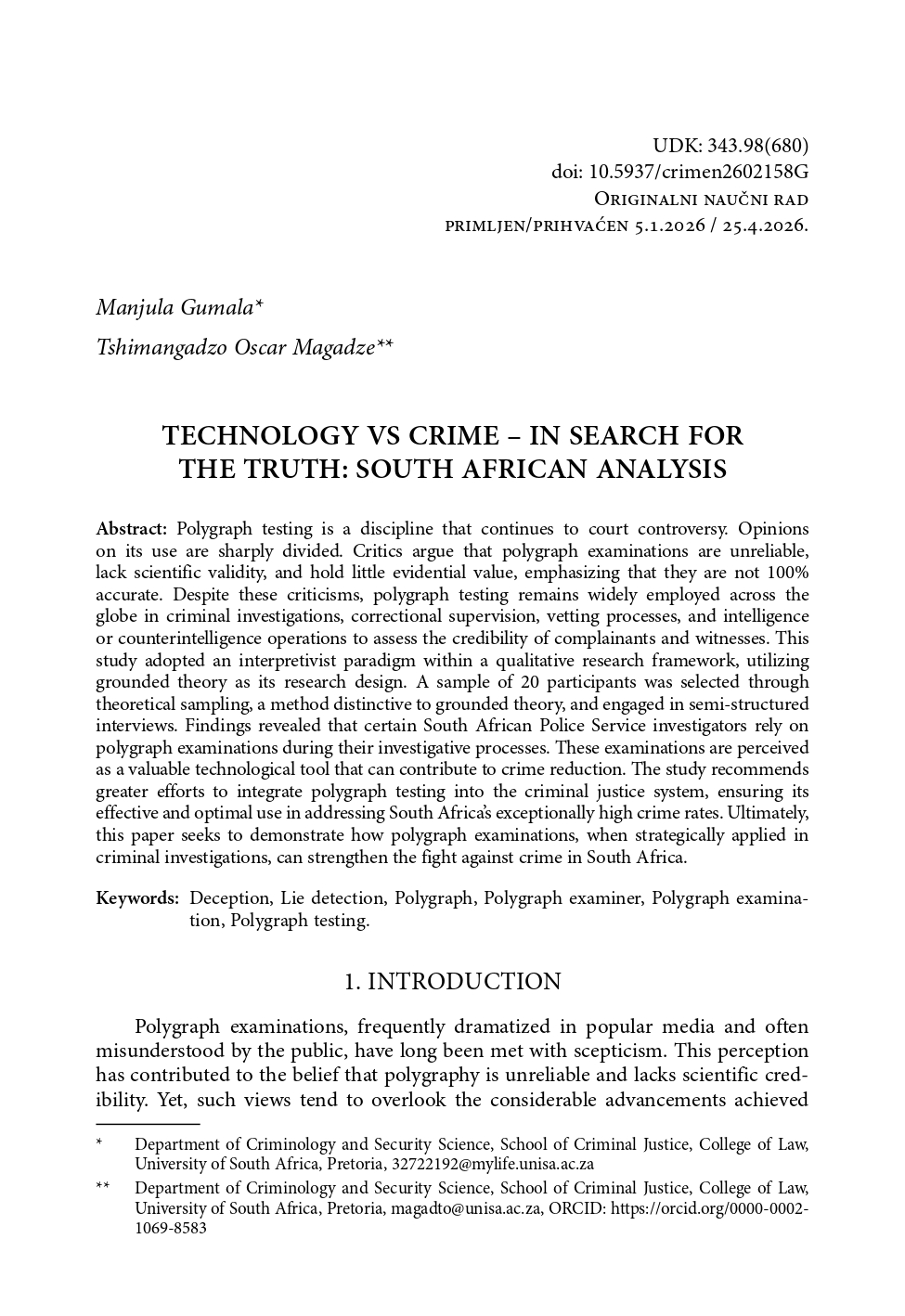
Polygraph testing is a discipline that continues to court controversy. Opinions on its use are sharply divided. Critics argue that polygraph examinations are unreliable, lack scientific validity, and hold little evidential value, emphasizing that they are not 100% accurate. Despite these criticisms, polygraph testing remains widely employed across the globe in criminal investigations, correctional supervision, vetting processes, and intelligence or counterintelligence operations to assess the credibility of complainants and witnesses. This study adopted an interpretivist paradigm within a qualitative research framework, utilizing grounded theory as its research design. A sample of 20 participants was selected through theoretical sampling, a method distinctive to grounded theory, and engaged in semi-structured interviews. Findings revealed that certain South African Police Service investigators rely on polygraph examinations during their investigative processes. These examinations are perceived as a valuable technological tool that can contribute to crime reduction. The study recommends greater efforts to integrate polygraph testing into the criminal justice system, ensuring its effective and optimal use in addressing South Africa’s exceptionally high crime rates. Ultimately, this paper seeks to demonstrate how polygraph examinations, when strategically applied in criminal investigations, can strengthen the fight against crime in South Africa.
Downloads
References
American Polygraph Association. Standards of Practice. American Polygraph Association, 2018.
Amsel, Tuvya. “Where there is doubt, there is freedom”. APA Magazine 48, no. 2 (2015): 32–36.
Bouma, Gary D., Rod Ling, Lori Wilkinson. The Research Process. Ontario: Oxford University Press, 2012.
Cilliers, Charles H., Raymond C. Martin. “The polygraph: Friend and ally of private industry yet cautious guest of the criminal justice system (1)”. Acta Criminologica: Southern African Journal of Criminology 5, no. 3 (2002): 134–140.
Claasens J. “Establishment of a polygraph unit in the National Detective Services, Training of Polygraph Examiners and Acquisition of Polygraph Instruments and Equipment”. Internal declassified document. South African Police Service, 1997. https://doi.org/10.1515/ep-2017-0008
Commission for Conciliation, Mediation and Arbitration (CCMA). Polygraph Testing. Information sheet. 2002.
Creswell, John W., J David Creswell. Research Design: Qualitative, Quantitative and Mixed Methods Approaches. Los Angeles: Sage, 2018. https://doi.org/10.1080/15424065.2022.2046231
Forensic Science Laboratory. Forensic Polygraph Induction Programme Learner Guide. Internal document, Polygraph Section, 2016.
Forensic Science Laboratory. Forensic Polygraph Induction Programme Learner Guide. Internal document, Polygraph Section, 2020.
Grubin, Don. “The Polygraph and Forensic Psychiatry”. Journal of the American Academy of Psychiatry and the Law 38, no. 4 (2010): 446–451.
Grubin, Don. “Polygraph Testing of Sex Offenders. Treatment of Sex Offenders: Strengths and weaknesses in assessment and intervention”. Polygraph 45, no. 2 (2016): 97–112. https://doi.org/10.1007/978-3-319-25868-3_6
Handler, Mark, Charles R. Honts, Benjamin Blalock. “A literature review of polygraph: Countermeasures and the comparison question technique”. APA Magazine 48, no. 3 (2015): 81–96.
Herbig, Friedo J. W. “Polygraph screening in the South African workplace: Veracity, verification or victimisation?”. Acta Criminologica: Southern African Journal of Criminology 31, no. 1 (2018): 54–67.
Honts, Charles R. “The psychophysiological detection of deception”. In The detection of deception in forensic contexts, ed. Par A. Granhag, Leif Strӧmwall. Cambridge: Cambridge University Press, 2004, 103–123. https://doi.org/10.1017/cbo9780511490071.005
Janušauskas, Antanas. “Dilemma of lies detection in criminalistics research”. Journal of Law and Criminal Justice 2, no. 1 (2014): 137–149.
Joubert Cerita. Applied Law for Police Officials. Claremont: Juta, 2010.
Krapohl, Donald J. “Common pitfalls in calculating decision accuracy with field cases”. APA Magazine 48, no. 3 (2015): 65–70.
Krapohl, Donald J., Mark Handler, Shirley Sturm. Terminology reference for the science of Psychophysiological Detection of Deception. Washington, DC: American Polygraph Association, 2012. https://doi.org/10.1016/b978-0-12-802924-4.09997-7
Krapohl, Donald J., Pamela K. Shaw. Fundamentals of Polygraph Practice. San Diego: Academic Press, 2015. https://doi.org/10.1016/b978-0-12-802924-4.00006-2
Lafayette Instrument. “The truth about polygraph and how does it work?” https://lafayettepolygraph.com/truth-about-polygraph/. https://doi.org/10.2307/j.ctv346tq5.5
Lee, Henry C., Elaine M. Pagliaro. “Forensic evidence and crime scene investigation”. Journal of Forensic Investigation 1, no. 2 (2013): 1–5.
Lissitzyn Christine Beck. Forensic Evidence in Court: A case study approach. Durham: North Carolina Academic Press, 2006.
Marks Andhor G. “Polygraph testing in the South African workplace: The law and practice”. Unpublished MPhil Dissertation. University of Cape Town, 2014.
Matte James Allen. Forensic Psychophysiology using the polygraph. New York: JAM Publications, 1996.
National Research Council. The polygraph and lie detection. Washington, DC: National Academies Press, 2003.
Nelson, Raymond. “What does polygraph measure?”. APA Magazine 47, no. 2 (2014): 39–47.
Nelson, Raymond. “Testing the limits of admissions”. Paper presented at the 50th Annual APA Seminar of the American Polygraph Association, held in Chicago on 30 August to 5 September 2015.
Nelson, Raymond. “One-word essay (more or less): What does polygraph measure?”. APA Magazine 48, no. 2 (2015): 29–31.
Nelson, Raymond. “Testing the limits of evidence-based polygraph practices”. Polygraph 45, no. 1 (2016): 74–85.
Nelson Raymond, Mark Handler. “Do test results matter?”. APA Magazine 47, no. 1 (2014): 24–25.
Raskin, David C. “Science and the polygraph profession”. APA Magazine 48, no. 2 (2015): 25–28.
Rheeder Johanette R. Polygraph testing and labour law. Cibolo, TX: Veridicus International Polygraph Academy, 2012.
Sekharan, Chandra P. “Truth and truth detecting techniques”. Journal of Forensic Research, no. 11 (2013): 1–11. https://doi.org/10.4172/2157-7145.s11-002
Sosnowski, Daniel. “Investigators' use of polygraph”. Free PATCE Newsletter. 2008. http://www.patc.com/weeklyarticles/polygraph-investigation.shtml.
Sosnowski, Daniel. “Tech talk – Inconclusive polygraph results – Why?”. APA Magazine 41, no. 1 (2008): 47.
South African Police Service. “Establishment of a polygraph unit in the SAPS”. Internal declassified document. SAPS, 1997.
South African Police Service. “Polygraph units in the SAPS”. Internal declassified document. SAPS, 1998.
South African Police Service. Annual performance plan 2017/2018. Pretoria: Commissioner of Police, 2018.
Tredoux, Colin G., Susan Pooley. “Polygraph testing of deception: An evaluation and commentary”. Industrial Law Journal 22 (2001): 819–839.
United States Department of Justice, Office of the Inspector General, Evaluation and Inspections Division. Use of polygraph examinations in the Department of Justice. 2006.
Vicianova, Martina. “Historical techniques of lie detection”. Europe’s Journal of Psychology 11, no. 3 (2015): 522–534. https://doi.org/10.5964/ejop.v11i3.919
Vrij Aldert. Detecting lies and deceit: Pitfalls and opportunities. Chichester: Wiley, 2007. https://doi.org/10.1515/9783110276794.321
Watson Gerald A. “An examination of the operational application and utilisation of polygraph testing: A case study in the Limpopo province”. Unpublished MTech Dissertation. University of South Africa, Pretoria, 2011.
Downloads
Published
How to Cite
Issue
Section
License
Copyright (c) 2026 Manjula Gumala, Tshimangadzo Oscar Magadze

This work is licensed under a Creative Commons Attribution 4.0 International License.
The authors retain copyright and grant the journal the right of first publication, allowing others to share the work with proper attribution to the authors and acknowledgment of its original publication in this journal.