Freedom of Expression and Ultima Ratio Societatis
DOI:
https://doi.org/10.5937/crimen2503291IKeywords:
freedom of expression, ultima ratio societatis, verbal offense, political trial, reactive or activist stateAbstract
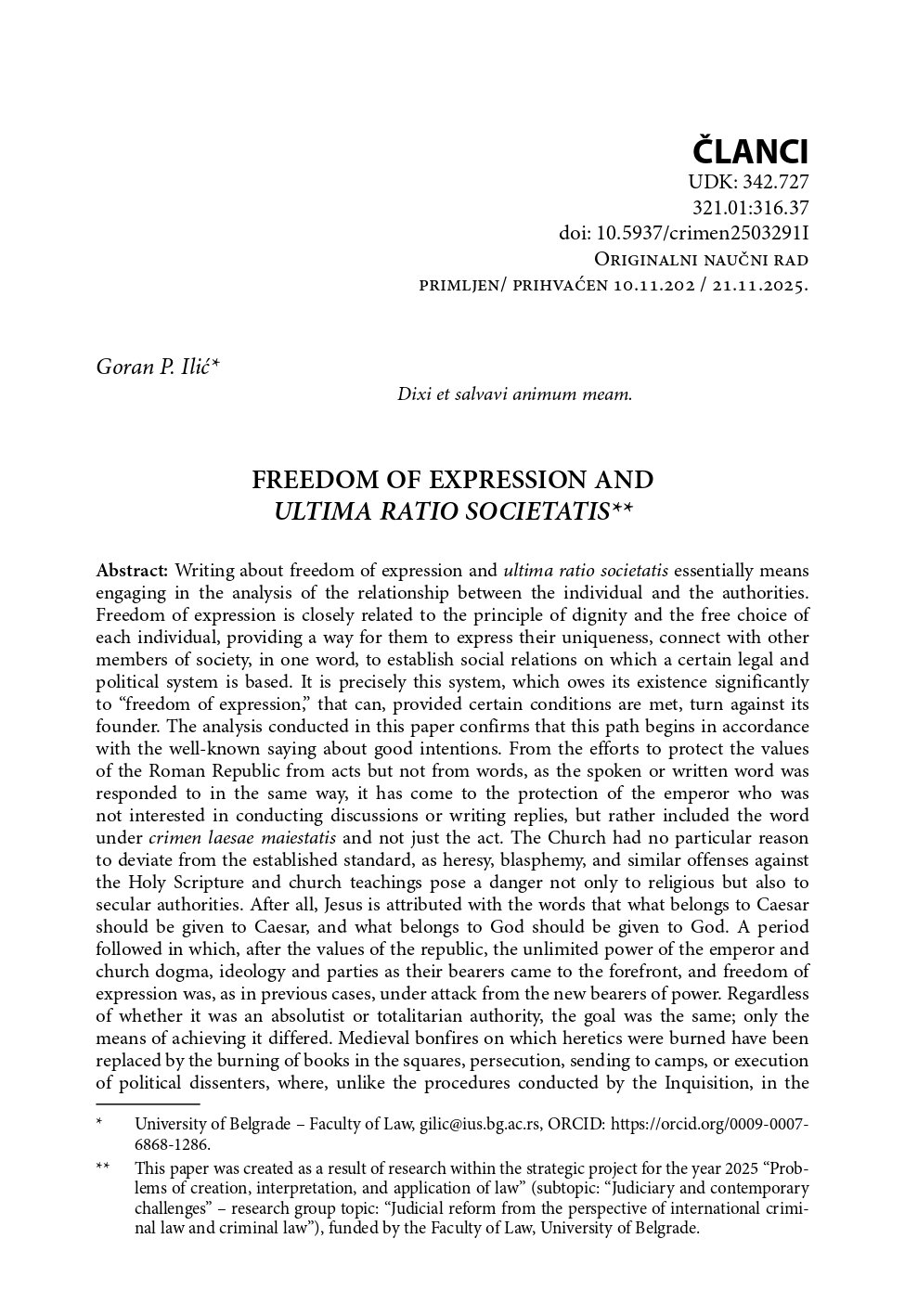
Writing about freedom of expression and ultima ratio societatis essentially means engaging in the analysis of the relationship between the individual and the authorities. Freedom of expression is closely related to the principle of dignity and the free choice of each individual, providing a way for them to express their uniqueness, connect with other members of society, in one word, to establish social relations on which a certain legal and political system is based. It is precisely this system, which owes its existence significantly to “freedom of expression,” that can, provided certain conditions are met, turn against its founder. The analysis conducted in this paper confirms that this path begins in accordance with the well-known saying about good intentions. From the efforts to protect the values of the Roman Republic from acts but not from words, as the spoken or written word was responded to in the same way, it has come to the protection of the emperor who was not interested in conducting discussions or writing replies, but rather included the word under crimen laesae maiestatis and not just the act. The Church had no particular reason to deviate from the established standard, as heresy, blasphemy, and similar offenses against the Holy Scripture and church teachings pose a danger not only to religious but also to secular authorities. After all, Jesus is attributed with the words that what belongs to Caesar should be given to Caesar, and what belongs to God should be given to God. A period followed in which, after the values of the republic, the unlimited power of the emperor and church dogma, ideology and parties as their bearers came to the forefront, and freedom of expression was, as in previous cases, under attack from the new bearers of power. Regardless of whether it was an absolutist or totalitarian authority, the goal was the same; only the means of achieving it differed. Medieval bonfires on which heretics were burned have been replaced by the burning of books in the squares, persecution, sending to camps, or execution of political dissenters, where, unlike the procedures conducted by the Inquisition, in the not-so-distant history of state and political upheavals and turmoil, trials for verbal offenses were often seen as unnecessary because the outcome was known in advance or, when raison d’état required it, conducted with clearly defined roles and concluded with the conviction of the accused who was convinced that he would not be punished for spoken words or written works. Such behavior can be associated with an activist type of state in which the individual is subordinated to the common good, that is, the interest of the community, and it is not unusual that the shadow of “Big Brother” looms over his freedom of expression. On the other hand, the reactive type of state was supposed to represent a more favorable, and it could even be said a natural environment for freedom of expression. The change in the attitude towards freedom of expression occurs particularly after the terrorist attack on September 11, 2001, the year when mass surveillance, military interventions in the world, and the restrictions faced by media representatives testify that things are moving towards restrictions on freedom of expression. Political dictates come to the fore, and the role of the judiciary becomes secondary. Moreover, for certain states of Western democracies, it can be said that they use the criminal system in a way that, although not in the form of blatant repression, treats representatives of the journalistic profession as potential perpetrators.
Downloads
References
Andrić, Ivo. “Most na Žepi.” In Put Alije Đerzeleza: Izbor pripovedaka 1, 41–49. Beograd: Slovo ljubve, 1980.
Arendt, Hannah. The Origins of Totalitarianism. New edition with added prefaces. New York: Harcourt Brace Jovanovich, 1973.
Armstrong, Martin. “Julian Assange: A Timeline of Events.” statista. Last modified 2024. Accessed November 1, 2025. https://www.statista.com/chart/17695/julian-assange-arrest/.
Basta, Danilo N. “Nekrolog akademiku Mihailu Đuriću (1925–2011).” Hereticus, no. 3–4 (2011): 337–41.
The Holy Bible Containing the Old and New Testaments. n.p.: Covenant Press of the Covenant Christian Coalition, 2020. https://www.ccc.one.
Council of Europe, Parliamentary Assembly. “Parliamentary Assembly Recognises Julian Assange as a ‘Political Prisoner’ and Warns against the Chilling Effect of His Harsh Treatment.” 2024. Accessed November 1, 2025. https://www.coe.int/en/web/portal/-/pace-recognises-julian-assange-as-a-political-prisoner-andwarns-against-the-chilling-effect-of-his-harsh-treatment.
Cvetković, Srđan. “Krivičnopravne osnove političke represije u Srbiji 1944–1985.” CRIMEN – Časopis za krivične nauke, no. 2 (2024): 190–206. https://doi.org/10.5937/crimen2402190C
Cvetković, Srđan. “„Proces šestorici” početak kraja ideološkog progona u socijalističkoj Srbiji.” Tokovi istorije: Časopis Instituta za noviju istoriju Srbije, no. 3 (2012): 242–56. https://doi.org/10.31212/tokovi.2012.3.cve.242-256
Čavoški, Kosta. “O moralno-političkoj podobnosti.” In Revolucionarni makijavelizam i drugi eseji, 156–62. Beograd: Izdavačka radna organizacija “Rad,” 1989.
Čavoški, Kosta. O neprijatelju. Beograd: Prosveta, 1989.
Damaška, Mirjan R. Dokaz krivnje: Od rimsko-kanonskog do suvremenog prava. Zagreb: Školska knjiga d.d., 2021.
Damaška, Mirjan. Evaluation of Evidence: Pre-Modern and Modern Approaches. Cambridge: Cambridge University Press, 2019. https://doi.org/10.1017/9781108667326
Damaška, Mirjan. Faces of Justice and State Authority: A Comparative Approach to the Legal Process. New Haven, CT: Yale University Press, 1986.
Đokić, Ivan. “Nekoliko zapažanja o noveli Krivičnog zakonika – usvojena i planirana rešenja.” In Izazovi međunarodnog krivičnog prava i krivičnog prava, vol. 1, edited by Milan Škulić et al., 151–67. Beograd: Udruženje za međunarodno krivično pravo, 2025. https://doi.org/10.51204/Zbornik_UMKP_25105A
Đurić, Mihailo. “Smišljene smutnje.” Anali Pravnog fakulteta u Beogradu, no. 3 (1971): 230–33.
Favoreu, Louis, Patrick Gaïa, Richard Ghevontian, Jean-Louis Mestre, Otto Pfersmann, André Roux, and Guy Scoffoni. Droit des libertés fondamentales. Paris: Dalloz, 2009.
Fondacija Slavko Ćuruvija. “Obračun države sa Ćuruvijom: Uzeli mu novine i novac. Osudili ga na robiju. Ubili.” 2016. Accessed November 1, 2025. https://www.slavkocuruvijafondacija.rs/obracun-drzave-sa-curuvijom-uzeli-mu-novine-i-novac-osudili-ga-na-robiju ubili/.
Foucault, Michel. La société punitive: Cours au Collège de France, 1972–1973. Paris: Gallimard/Seuil, 2013.
Foucault, Michel. Théories et institutions pénales: Cours au Collège de France, 1971–1972. Paris: Gallimard/Seuil, 2021.
Hutchinson, Bill. “Timeline of Julian Assange’s 14-year-long Saga to Dodge Extradition.” abcNEWS. 2024. Accessed November 1, 2025. https://abcnews.go.com/US/timeline-julian-assanges-14-yearlong-saga-dodge/story?id=111398254.
Ilić, Aleksandra. “Ekstradicija između prava i politike.” In Odnos međunarodnog krivičnog prava i nacionalnog krivičnog prava, vol. 1, edited by Milan Škulić et al., 375–93. Beograd: Udruženje za međunarodno krivično pravo, 2024. https://doi.org/10.51204/Zbornik_UMKP_24119A
Ilić, Goran P. “Freedom of Expression and the Right to Respect for Private Life.” Serbian Political Thought, no. 2 (2020): 249–65. https://doi.org/10.22182/spm.7042020.13
Ilić, Goran P. “Rat i pravično suđenje – contradictio in adiecto?” In Odnos međunarodnog krivičnog prava i nacionalnog krivičnog prava, vol. 1, edited by Milan Škulić et al., 293–324. Beograd: Udruženje za međunarodno krivično pravo, 2024. https://doi.org/10.51204/Zbornik_UMKP_24116A
Jarmaz, Reskušić Ivana. “Augustove reforme kaznenog prava i pravosuđa.” Hrvatski ljetopis za kazneno pravo i praksu, no. 1 (2006): 297–332.
Katančević, Andreja. “Nastanak krivičnog dela uvrede.” Srpska politička misao, no. 3 (2020): 327–41. https://doi.org/10.22182/spm.6932020.13
Koprivica, Časlav D. “Misao i čast kao sudbina.” In Čuvar dostojanstva filozofije: Spomenica o godišnjici smrti akademika Mihaila Đurića (1925–2011), edited by Danilo N. Basta, 130–70. Beograd: Dosije studio, 2011.
Kras, Paweł. The System of the Inquisition in Medieval Europe. Berlin: Peter Lang, 2020. https://doi.org/10.3726/b17382
Lazarević, Ljubiša. Krivično pravo Jugoslavije: posebni deo. 8th ed. Beograd: Savremena administracija, 1995.
Maifreda, Germano. The Trial of Giordano Bruno. New York: Routledge, 2022. https://doi.org/10.4324/9781003026082
Marchand, Christophe. “The Detention of Julian Assange Is Inhumane.” European Center for Constitutional and Human Rights. 2016. Accessed November 1, 2025. https://www.ecchr.eu/en/publication/the-detention-of-julian-assange-is-inhumane/.
Margera, Danijel. Život i sudbina Isusa iz Nazareta. Novi Sad: Akademska knjiga, 2021.
Marx, Karl. Kritik des Gothaer Programms. Neu durchgesehene und vermehrte Ausgabe. Berlin: Verlag Neuer Weg Gmbh, 1946.
Melander, Sakari. “Ultima Ratio in European Criminal Law.” Oñati Socio-Legal Series 3, no. 1 (2013): 42–61. https://doi.org/10.5235/219174413806915441
“Mesarović: Demanti povodom teksta o Ćuruviji.” Radio Slobodna Evropa. 2012. Accessed November 1, 2025. https://www.slobodnaevropa.org/a/demanti_nade_mesarovic_povodom_teksta_rse_o_slavki_curuviji/24525077.html.
Mihailović, Dragoslav. “Modernisti prećutkuju Goli otok.” In Crveno i plavo, 77–103. Novo Miloševo: Banatski kulturni centar, 2020.
Mihailović, Dragoslav. Kratka istorija satiranja. Beograd: Zavod za udžbenike i nastavna sredstva, 2005.
Mommsen, Theodor. Le droit pénal romain. Vol. 1. Paris: Libraire des Écoles françaises d’Athènes et de Rome de l’Institut français d’archéologie orientale du Caire du Collège de France et de l’École normal supérieur, 1907.
Mousourakis, George. A Legal History of Rome. Abingdon, UK: Routledge, 2007. https://doi.org/10.4324/9780203089347
“Ne pljuj po podu, ili – nekoliko reči o pravdi.” Peščanik. March 5, 2004. Accessed November 1, 2025. https://pescanik.net/ne-pljuj-po-podu-ili-nekoliko-reci-o-pravdi/.
Ortiz, Vincent. “Ce que l’affaire Assange révèle du pouvoir américain depuis le 11 septembre.” Le Vent Se Lève. 2021. Accessed November 1, 2025. https://lvsl.fr/ce-que-laffaire-assange-revele-du-pouvoir-americain-depuis-le-11-septembre/.
Pekić, Borislav. Godine koje su pojeli skakavci: Uspomene iz Zatvora ili Antropopeja (1948–1954). Vol. 1. Beograd: Laguna, 2013.
Popović, Srđa M. Poslednja instanca: Knjiga 2, Svedočanstva 17. Beograd: Helsinški odbor za ljudska prava u Srbiji, 2003.
Rabb, Maxwell. “New Banksy Mural Appears at Royal Courts of Justice in London.” Artsy. 2025. Accessed November 1, 2025. https://www.artsy.net/article/artsy-editorial-new-banksy-mural-appears-royal-courts-justice-london.
Renucci, Jean-François. Traité de droit européen des droits de l’homme: Droit européen des droits de l’homme. Paris: LGDJ, 2012.
Škulić, Milan, and Natalija Lukić. “The Explanation of the Main Characteristics of Penal Populism and Examples of Penal Populism in Some Criminal Law Provisions and Planned Amendments of the Criminal Code of Serbia.” CRIMEN – Časopis za krivične nauke, no. 1 (2025): 3–40. https://doi.org/10.5937/crimen2501003S
Spaić, Tamara. “Zakon o informisanju iz 1998: Institucionalni zločin nad medijima i novinarima.” Cenzolovka. 2020. Accessed November 1, 2025. https://www.cenzolovka.rs/pritisci-i-napadi/zakon-o-informisanju-iz-1998-institucionalni-zlocin-nad-medijima-i-novinarima/.
Tacitus. Annales. Paris: GF Flammarion, 1965.
Tagirov, Tanja. “Presude, pobude, posledice.” Vreme. 2012. Accessed November 1, 2025. https://vreme.com/vreme/presude-pobude-posledice/.
Trivić, Branka. “Ćuruvija – kostur u ormaru g-đe Mesarović.” Radio Slobodna Evropa. 2012. Accessed November 1, 2025. https://www.slobodnaevropa.org/a/curuvija_kostur_u_ormaru_gospodje_mesarovic/24523300.html.
Trkulja, Jovica. Osuda, izgon i rehabilitacija Mihaila Đurića. 2nd ed. Beograd: Centar za unapređenje pravnih studija, Dosije studio, 2013.
Trkulja, Jovica. “Etos javnog delovanja Mihaila Đurića.” In Čuvar dostojanstva filozofije: Spomenica o godišnjici smrti akademika Mihaila Đurića (1925–2011), edited by Danilo N. Basta, 251–85. Beograd: Dosije studio, 2012.
Vuković, Igor. Krivično pravo: opšti deo. Beograd: Centar za izdavaštvo Univerzitet u Beogradu – Pravni fakultet, 2021.
Wachsmann, Patrick. “La liberté d’expression.” In Libertés et droits fondamentaux, edited by Rémy Cabrillac, Marie-Anne Frison-Roche, and Thierry Revet, 449–86. Paris: Dalloz, 2012.
Downloads
Published
How to Cite
Issue
Section
License
Copyright (c) 2025 Goran P. Ilić

This work is licensed under a Creative Commons Attribution 4.0 International License.
The authors retain copyright and grant the journal the right of first publication, allowing others to share the work with proper attribution to the authors and acknowledgment of its original publication in this journal.