Colonial Genocides
DOI:
https://doi.org/10.5937/crimen2503318RKeywords:
colonizer, Indigenous peoples, extermination, crime, incrimination, convention, qualification, intentAbstract
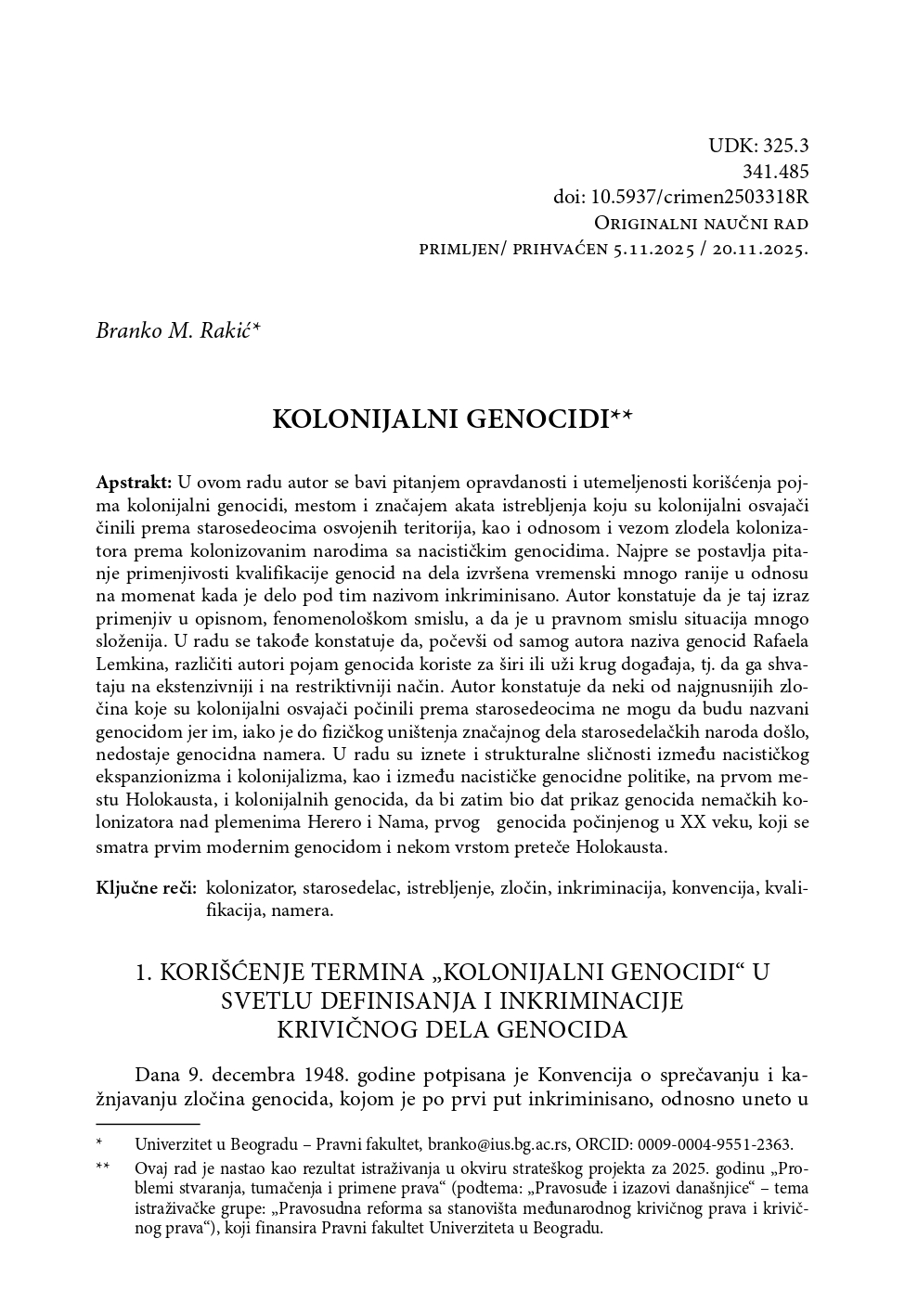
In this paper, the author addresses the question of the justification and validity of using the term colonial genocides, as well as the place and significance of acts of extermination committed by colonial conquerors against the Indigenous peoples of the territories they seized, and the relationship and connection between the crimes of colonizers against colonized peoples and the Nazi genocides. The paper first raises the question of whether the qualification genocide can be applied to acts committed long before the term was legally defined and criminalized. The author notes that the term is applicable in a descriptive, phenomenological sense, whereas in the legal sense the situation is much more complex. The paper also observes that, starting with the very creator of the term genocide, Raphael Lemkin, various authors use the concept to describe a broader or narrower set of events— i.e., they understand it either more extensively or more restrictively. The author concludes that some of the most heinous crimes committed by colonial conquerors against Indigenous peoples cannot be called genocide because, although a significant portion of Indigenous populations was physically destroyed, the genocidal intent is absent. The paper also outlines the structural similarities between Nazi expansionism and colonialism, as well as between Nazi genocidal policies—especially the Holocaust—and colonial genocides. It then presents an overview of the genocide committed by German colonizers against the Herero and Nama peoples, the first genocide of the 20th century, considered the first modern genocide and a kind of precursor to the Holocaust.
Downloads
References
Bassiouni, M. Cherif. Crimes against Humanity: Historical Evolution and Contemporary Application. Cambridge: Cambridge University Press, 2011. https://doi.org/10.1017/CBO9780511976537
Beal, Baldwin. “An Examination of the Instability and Exploitation in Congo From King Leopold II’s Free State to the 2nd Congo War.” *HIM 1990-2015*, 2014.
Cassese, Antonio. “The Martens Clause: Half a Loaf or Simply Pie in the Sky?” European Journal of International Law 11, no. 1 (2000): 187–216. https://doi.org/10.1093/ejil/11.1.187
Docker, John. “Raphael Lemkin’s History of Genocide and Colonialism.” Paper for United States Holocaust Memorial Museum, Center for Advanced Holocaust Studies, Washington DC, 2004. https://www.ushmm.org/m/pdfs/20040316-docker-lemkin.pdf.
Doyle, Arthur Conan. The Crime of the Congo. London: Hutchinson & Co., 1909.
Fenn, Elizabeth A. “Biological Warfare in Eighteenth-Century North America: Beyond Jeffery Amherst.” The Journal of American History 86, no. 4 (2000): 1552–80. https://doi.org/10.2307/2567577
Fenner, Frank, Donald Ainslie Henderson, Isao Arita, Zdenek Ježek, and Ivan Danilovich Ladnyi. Smallpox and Its Eradication. Geneva: World Health Organization, 1988.
Gallito, Hilary. “A Usable Past: Raphael Lemkin on the Intersection of Colonialism, Religion, and Genocide.” Webster Review of International History 5, no. 2 (2025): 1–25.
Häußler, Matthias. “From Destruction to Extermination: Genocidal Escalation in Germany’s War against the Herero.” Journal of Namibian Studies 10 (2011): 55–81.
Hull, Isabel V. “Military Culture and the Production of ‘Final Solutions’ in the Colonies: The Example of Wilhelminian Germany.” In The Specter of Genocide: Mass Murder in Historical Perspective, edited by Robert Gellately and Ben Kiernan, 141–62. Cambridge: Cambridge University Press, 2003. https://doi.org/10.1017/CBO9780511819674.007
Johnson, Steven. “King Leopold II’s Exploitation of the Congo From 1885 to 1908 and Its Consequences.” *HIM 1990-2015*, 2014.
Lemkin, Raphael. Axis Rule in Occupied Europe. Washington, DC: Carnegie Endowment for International Peace, 1944.
Lemkin, Raphael. Lemkin on Genocide. Edited and introduced by Steven Leonard Jacobs. Lanham, MD: Lexington Books, 2012.
Lippman, Matthew. “Genocide: The Trial of Adolf Eichmann and the Quest for Global Justice.” Buffalo Human Rights Law Review 8 (2002): 45–121.
Lösing, Felix. ‘A Crisis of Whiteness in the Heart of Darkness’: Racism and the Congo Reform Movement. Bielefeld: transcript Verlag, 2020. https://doi.org/10.1515/9783839454985
Melber, Henning. “Colonialism, Genocide and Reparations: The German-Namibian Case.” Development and Change 55, no. 4 (2024): 773–99. https://doi.org/10.1111/dech.12840
Paunović, Milan, Boris Krivokapić, and Ivana Krstić. Međunarodna ljudska prava. Beograd: Pravni fakultet Univerziteta u Beogradu, 2023.
Radisavljević, Ivana. “Nezastarevanje međunarodnih krivičnih dela u užem smislu.” In Odnos međunarodnog krivičnog i nacionalnog krivičnog prava, edited by Milan Škulić et al., 575–88. Beograd: Udruženje za međunarodno krivično pravo, Univerzitet u Beogradu – Pravni fakultet, 2024. http://dx.doi.org/10.51204/Zbornik_UMKP_24128A
Rakić, Branko M. “Ustaški genocid nad Srbima – dolus specialis koji traje.” Časopis za političku teoriju i praksu „Napredak” 3, no. 2 (2022): 69–102. https://doi.org/10.5937/napredak3-39804
Roes, Aldwin. “Towards a History of Mass Violence in the Etat Indépendant du Congo, 1885–1908.” South African Historical Journal 62, no. 4 (2010): 634–70. https://doi.org/10.1080/02582473.2010.519937
Schabas, William A. The International Legal Order’s Colour Line: Racism, Racial Discrimination, and the Making of International Law. Oxford: Oxford University Press, 2023. https://doi.org/10.1093/oso/9780197744475.001.0001
Schabas, William. “What Is Genocide? What Are the Gaps in the Convention? How to Prevent Genocide?” Politorbis 47, no. 2 (2009): 33–46.
Silvester, Jeremy, and Jan-Bart Gewald, eds. Words Cannot Be Found: German Colonial Rule in Namibia: An Annotated Reprint of the 1918 Blue Book. Leiden: Brill, 2003. https://doi.org/10.1163/9789047400042
Šuvaković, Uroš V., and Branko M. Rakić. “Genocid i etničko čišćenje ili o odnosu dispozicije jednog međunarodnog krivičnog dela i jednog sociološko-politikološkog pojma.” Strani pravni život 61, no. 2 (2017): 59–75.
Weisbord, Robert G. “The King, the Cardinal and the Pope: Leopold II’s Genocide in the Congo and the Vatican.” Journal of Genocide Research 5, no. 1 (2003): 35–45. https://doi.org/10.1080/14623520305651
Zimmerer, Jürgen. From Windhoek to Auschwitz? Reflections on the Relationship between Colonialism and National Socialism. Berlin: de Gruyter Oldenbourg, 2024. https://doi.org/10.1515/9783110754513
Downloads
Published
How to Cite
Issue
Section
License
Copyright (c) 2025 Branko Rakić

This work is licensed under a Creative Commons Attribution 4.0 International License.
The authors retain copyright and grant the journal the right of first publication, allowing others to share the work with proper attribution to the authors and acknowledgment of its original publication in this journal.