Chronology of Events as a Refutation of Allegations of Participation of the Serbian Leadership in a “Joint Criminal Enterprise” in Bosnia and Herzegovina
DOI:
https://doi.org/10.5937/crimen2601003R%20Keywords:
politicization, purpose, goal, anticipation, unlawfulness, compensation, proportionalityAbstract
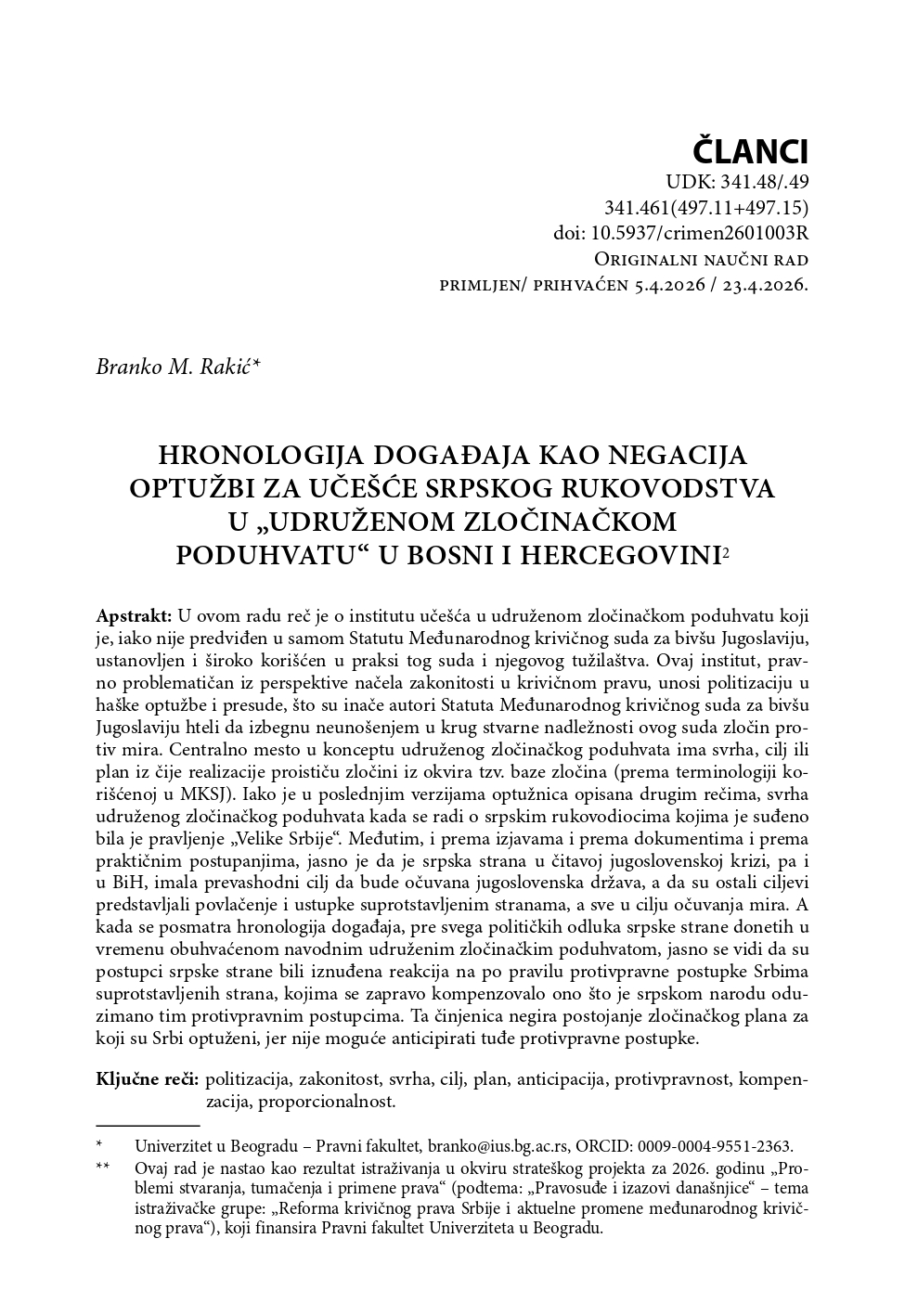
This paper examines the doctrine of participation in a joint criminal enterprise (JCE), which, although not expressly provided for in the Statute of the International Criminal Tribunal for the former Yugoslavia (ICTY), was nevertheless established and extensively applied in the jurisprudence of the Tribunal and its Office of the Prosecutor. As developed in ICTY case law, JCE functions as a mode of liability enabling the attribution of criminal responsibility to individuals participating in a common criminal purpose . From the perspective of the principle of legality in criminal law, this doctrine raises significant concerns, as it risks introducing elements of legal uncertainty and retroactive expansion of criminal liability. Moreover, its application has arguably contributed to the politicization of indictments and judgments rendered in The Hague—an outcome the drafters of the ICTY Statute sought to avoid, inter alia, by excluding the crime against peace from the Tribunal’s jurisdiction. At the core of the concept of joint criminal enterprise lies the existence of a common purpose, objective, or plan, the implementation of which results in crimes falling within the so-called “crime base” (in the terminology employed by the ICTY). Although later indictments articulated this element in different terms, the alleged purpose of the joint criminal enterprise in cases involving Serbian political and military leaders was framed as the creation of a “Greater Serbia.” However, an analysis of official statements, documentary evidence, and actual conduct suggests that, throughout the Yugoslav crisis—including in Bosnia and Herzegovina—the primary objective of the Serbian side was the preservation of the Yugoslav state. Other political goals appear rather as concessions and strategic withdrawals vis-à-vis opposing parties, undertaken with the overarching aim of maintaining peace. Furthermore, a chronological examination of relevant events—particularly political decisions adopted by the Serbian leadership during the period covered by the alleged joint criminal enterprise—indicates that their actions were largely reactive in nature. Specifically, they constituted responses to what were, as a rule, unlawful acts by opposing parties, aimed at compensating for losses inflicted upon the Serbian population through such conduct. This circumstance undermines the assertion of the existence of a preconceived criminal plan attributed to the Serbian side, as the very notion of such a plan presupposes the ability to anticipate unlawful actions of others—an assumption that is neither logically sustainable nor factually substantiated.
Downloads
References
Antić, Čedomir, Nenad Kecmanović. Istorija Republike Srpske. Beograd: Laguna, 2025.
Bekan, Milan, Pavle Jelisavčić, Predrag Aleksić. Nerazvejane BiH magle ili Zašto su se ubijali. Beograd: Radnička štampa, 2001.
Boas, Gideon. “Milošević Trial”. Max Planck Encyclopedia of Public International Law [MPE PIL]. Oxford Public International Law, Oxford University Press, dostupno na: https://opil.ouplaw.com/display/10.1093/law:epil/9780199231690/law-9780199231690-e1694. https://doi.org/10.1093/law:epil/9780199231690/e1694
Bogdanič, Džon, „Uvod u osvajanje Srebrenice“. U Masakr u Srebrenici: dokazi, kontekst, politika, ur. Edvard Herman. Beograd: Fond „Istorijski projekat Srebrenica“ (Holandija), 2011.
Cassese, Antonio. Self-determination of peoples. A legal reappraisal. Cambridge. Cambridge University Press, 1995. https://doi.org/10.7202/1100334ar
Čučilović, Irena. „Udruženi zločinački poduhvat u praksi međunarodnog krivičnog tribunala za bivšu Jugoslaviju“. Crimen 12, no. 1 (2021): 81–99. https://doi.org/10.5937/crimen2101081c
Elewa Bada, Mohamed. “’Just Convict Everyone!’ – Joint Perpetration: From Tadić to Stakić and Back Again“. International Criminal Law Review 6, no. 2 (2006): 293–302. https://doi.org/10.1163/157181206778050679
Glennon, Michael J. “The Blank-Prose Crime of Aggression”, The Yale Journal of International Law 35, no. 1 (2010): 71–114.
Oven, Dejvid. Balkanska odiseja. Beograd: Radio B92, 1996.
Scharf, Michael P. “Universal Jurisdiction and the Crime of Aggression”, Harvard International Law Journal 53, no. 2 (2012): 358–389.
Schomburg, Wolfgang. “Jurisprudence on JCE – Revisiting a never ending story about a judge made mode of criminal liability before some international criminal tribunals”. Godišnjak Akademije pravnih znanosti Hrvatske 3, no. 1 (2012): 59–92. https://doi.org/10.32984/gapzh
Stojanović, Zoran. Međunarodno krivično pravo. Beograd: Pravna knjiga, 2017.
Škulić, Milan. Međunarodno krivično pravo. Beograd: Univerzitet u Beogradu – Pravni fakultet, Centar za izdavaštvo, 2022. https://doi.org/10.26601/rsp.aprs.22.8
Škundrić, Aleksa. „Elementi načela utvrđivanja istine u normativnom okviru postupka pred Međunarodnim krivičnim sudom“. Crimen 13, no. 3 (2022): 284–303. https://doi.org/10.5937/crimen2203284s
Trifković, Srdja. “The impact of islam on the bosnian problem, The Myth of Harmonious Multiethnicity Revisited”. Politeia 2, no. 4 (December 2012): 309–320. https://doi.org/10.5937/pol1204309t
Velimirović, Janko, Milan Komljenović, Slavko Glamočić (ur.). Hronologija 1990–1995. Banja Luka: Dokumentacioni centar Republike Srpske, 2002. https://doi.org/10.18575/msrs.sm.s.16.01
Zečević, Miodrag, Bogdan Lekić. Državne granice i unutrašnja teritorijalna podela Jugoslavije. Beograd: Građevinska knjiga, 1991.
Downloads
Published
How to Cite
Issue
Section
License
Copyright (c) 2026 Branko Rakić

This work is licensed under a Creative Commons Attribution 4.0 International License.
The authors retain copyright and grant the journal the right of first publication, allowing others to share the work with proper attribution to the authors and acknowledgment of its original publication in this journal.